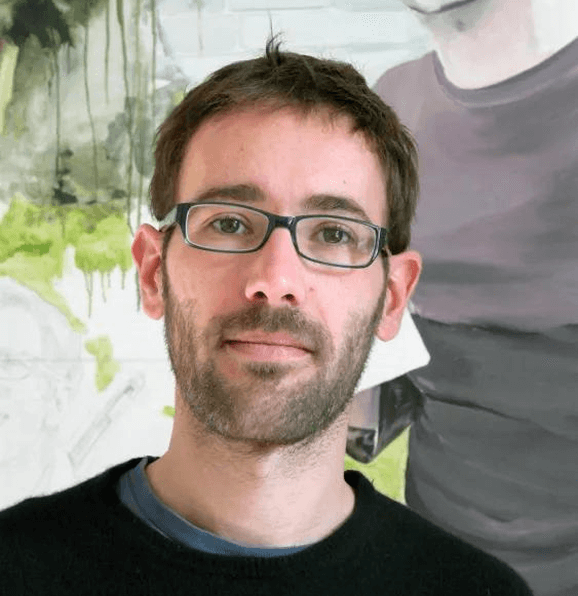
David Lefebvre
French contemporary painter exploring the visual translation of invisible systems.
Curatorial Perspective
David Lefebvre’s work unfolds at the threshold between what can be seen and what can only be sensed.
His paintings do not describe landscapes as places to inhabit, but as structures to be understood, mental, geographic, and systemic con structions shaped by forces that remain largely invisible.
Moving between figuration and abstraction, Lefebvre develops a pictorial language in which relief, rhythm, and rupture replace narrative. Mountains, valleys, horizons, and voids emerge not as representations of nature, but as translations of underlying systems: flows, tensions, accumulations, discontinuities.
What appears at first glance as landscape gradually reveals itself as a mental architecture, a space where perception is guided less by recognition than by orientation. The viewer is not invited to contemplate, but to navigate.
On Translating Systems into Landscape
Throughout his practice, Lefebvre approaches painting as a method of transposition.
Abstract structures, economic indices, geographic data, temporal sequences are absorbed into the materiality of paint and re-emerge as topographies.
In his CAC 40 series, this approach reaches a critical point. An index, stripped of narrative and identity, becomes a relief: peaks, slopes, tensions, and ruptures unfold across the canvas. The painting no longer illustrates the market; it gives it a body.
Here, the landscape ceases to be a backdrop. It becomes a system in itself governed by forces, exposed to imbalance, shaped by time. What is usually read as data is transformed into a space that can be felt, crossed, and confronted.
Artistic Position
Lefebvre’s work resists immediacy.
It requires distance, attention, and duration.
Rather than offering interpretation, his paintings create conditions for perception. They suspend meaning long enough for structure to appear. In doing so, they invite the viewer to consider how abstract systems economic, geographic, or conceptual imprint themselves onto lived experience.
This tension between visibility and invisibility lies at the core of his practice.
Selected Information
- Born in 1980, Vernon (France)
- Lives and works in Grenoble, France
- Graduated from École des Beaux-Arts de Grenoble
- Represented by Galerie Zürcher (Paris – New York)
- Works included in major institutional and corporate collections, including Société Générale Collection
Related Publication